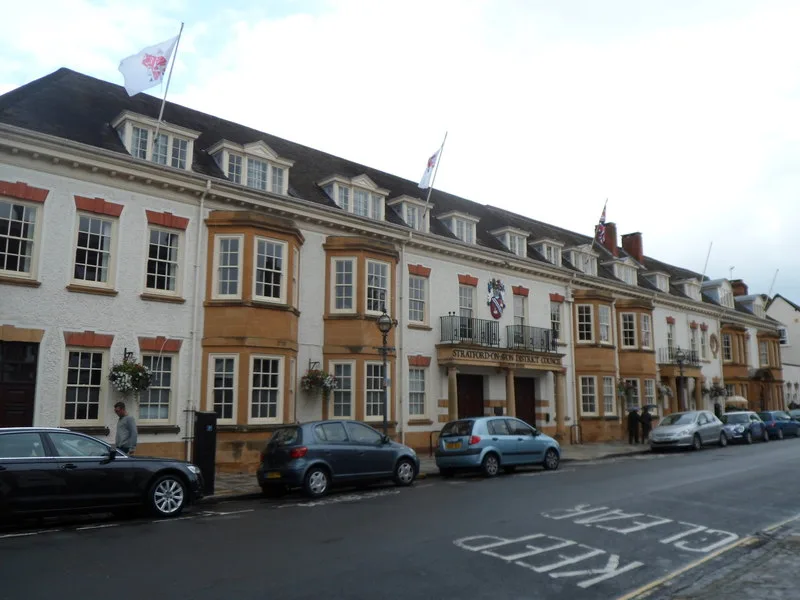

Ministers are minded to merge Stratford-on-Avon and Warwick districts into a South Warwickshire council of 295,000 people from April 2029. It is not yet final.
The government is once again planning to abolish Stratford-on-Avon District Council, a year later than first set. On Thursday 29 October the local government minister, Jim McMahon, said ministers are “minded to” replace Warwickshire’s six councils with two.
Stratford-on-Avon and Warwick districts would form a new South Warwickshire council. North Warwickshire, Nuneaton and Bedworth, and Rugby would form a North Warwickshire council. Both would take over from the county council as well.
The new timetable is:
- May 2027: the district council election goes ahead as normal
- May 2028: elections to the two new councils
- 1 April 2029: the new councils take over, and the district and county councils are abolished
This is a provisional view, not a final decision. A representations period of at least three weeks comes first, and Parliament must then approve an order.
What changed on 29 October
The government had chosen the same two-council model on 16 July, with an April 2028 start. On 7 September it paused that and every other July decision for a review, as we reported at the time.
The review has now finished its first phase. In a written statement to Parliament, Mr McMahon said the programme’s basis was “robust” and the government “remains committed to delivering local government reorganisation”.
Warwickshire is one of five areas to get a fresh “minded to” decision. The others are Gloucestershire, Oxfordshire, Worcestershire, and East Sussex with Brighton and Hove. The July decision for Warwickshire is formally withdrawn, and ministers are “considering the proposals afresh”.
Nine other areas, including Kent and Medway, had their July decisions withdrawn with no new view. Warwickshire is further ahead than they are.
How big South Warwickshire would be
The minister’s letter to Warwickshire council leaders gives the current population of each proposed council:
| Proposed council | Made up of | Population |
|---|---|---|
| South Warwickshire | Stratford-on-Avon and Warwick districts | 295,000 |
| North Warwickshire | North Warwickshire, Nuneaton and Bedworth, and Rugby | 323,000 |
The rival plan, a single Warwickshire council backed by the county council and Rugby Borough Council, would have served about 618,000 people.
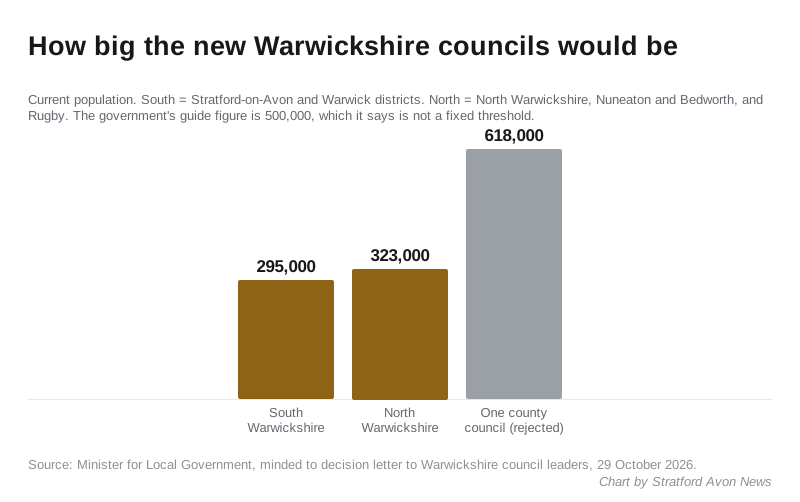
Both new councils would be below the government’s guide figure of 500,000. The letter says that figure “is not a fixed threshold”. It adds that single-tier councils with “a median population of around 275,000” have run the same services for decades.
Why ministers prefer two councils
The letter finds that both proposals meet all six of the government’s tests. It gives three reasons that “weigh particularly strongly” for two councils:
- they can respond to “the different economic, demographic, housing and service needs of the north and south”
- they can tailor public services to local needs, with more room for prevention
- they keep “flexibility” while devolution arrangements for the area are unresolved
For the south, the letter names the priorities as “healthy ageing, rural access and supporting independence”. On housing, it says a southern council “could provide a stronger focus on affordability pressures”.
The letter is also open about the downsides. Ministers have “lower confidence” in the two-council plan’s savings estimates. They judge the single council to have more scale and financial capacity. Splitting county services such as children’s social care, adult social care and SEND carries risks that ministers say “can be managed”.
The letter records about 2,000 responses to the statutory consultation. Most residents and organisations that responded preferred two councils, as did most Warwickshire MPs. The Police and Crime Commissioner and the local NHS Integrated Care Board preferred one.
What the councils said
All six Warwickshire councils, including Stratford-on-Avon District Council and the county council, issued a joint statement the same day. They said:
“Councils across Warwickshire have held different views on the best structure for local government. We remain committed to working together constructively and responsibly now that the Government has confirmed the way forward.”
They asked for “clear information from the Government about the timetable, funding and next steps”.
The money
Warwickshire will be paid £900,000 towards the cost of the change. That is half of the £900,000 promised for each of the two new councils. The letter says it will be paid in November “to the previously confirmed recipient authority”, without naming the council.
The rest, plus £150,000 per new council for leadership in children’s services, adult social care and public health, follows a final decision.
Stratford-on-Avon District Council has already set aside £1,000,000 in its 2026/27 budget for reorganisation work. At its 12 October meeting, councillors agreed to ask the government to pay back the council’s costs.
What it means for you
- Nothing changes yet about your services. The district council still collects your bins and decides planning applications. The county council still runs roads, schools and social care. See our bin collection days and planning news pages.
- You vote for district councillors in May 2027. That election goes ahead to the existing councils, the minister’s statement confirms.
- In May 2028 you would vote again, this time for South Warwickshire councillors, if the plan is confirmed.
- Your council tax still comes from the current councils until April 2029. Our council tax bands guide explains who gets what.
- You can have your say. The government will invite representations from councils and “other interested parties” for at least three weeks. The dates and the way to respond have not been published yet. We will add them here when they are.
What happens next
- The representations period. At least three weeks, with dates to be confirmed “shortly”.
- A final decision. The letter says ministers could still modify the plan, choose the single-council option, or decide against any change.
- A structural changes order. Nothing is legally settled until Parliament approves one.
Sources
- Written statement HCWS432, Local Government Reorganisation, 29 October 2026, Minister for Local Government, Devolution and Regional Growth, for the five minded-to areas, the nine withdrawn areas, the May 2027 elections, the May 2028 and April 2029 timetable and the funding.
- Local government reorganisation: minded to decision letter to Warwickshire council leaders, 29 October 2026, from the GOV.UK collection of minded to letters, for the two councils, populations, reasons, consultation responses, representations period and the £900,000 payment.
- Joint statement following Government announcement on local government reorganisation, Stratford-on-Avon District Council, 29 October 2026.
- Your Guide to Council Tax 2026/27, Stratford-on-Avon District Council, for the £1,000,000 reorganisation capacity budget.
Have your say