
The district can show 2.43 years of housing land against the five required. New homes fell to 626 last year, the lowest in five years. What the new figure changes.
Stratford-on-Avon District Council can now show 2.43 years of housing land supply, up from 2.21. The figure is still less than half the five years the government requires, so the council’s own policies on where homes should go keep their reduced weight. The number of homes actually finished fell for a fourth year running, to 626.
The council published the new calculation on 30 September. It is dated 31 March 2026 and covers the five years to March 2031. It reached the Planning Committee a week later as a line on the update sheet for the 7 October meeting, which went on to approve 38 homes at Harbury.
The calculation in one table
| Step | Figure | Note |
|---|---|---|
| Local housing need, per year | 1,084 | Standard method, May 2026 data |
| Five-year requirement | 5,420 | 1,084 x 5 |
| Plus 5% buffer | 5,691 | Buffer applied because delivery has been strong |
| Deliverable sites | 2,407 | Homes with permission or allocated, expected within five years |
| Older persons’ accommodation | 33 | 62 bedspaces, converted at 1.9 adults per unit |
| Small site windfall allowance | 324 | 162 a year, counted in years four and five only |
| Total supply | 2,764 | |
| Years of supply | 2.43 | 2,764 divided by 1,138 a year |
| Shortfall | 2,927 | Against the buffered requirement |
All figures are from Table 6 of the council’s paper.
Two things moved the number from 2.21 to 2.43. The housing need figure fell from 1,112 to 1,084 a year, because updated dwelling stock and affordability data went into the government’s standard method in May 2026. And the supply side was recounted at the new base date.
Completions have fallen for four years
The paper is blunt about delivery. It says 2021/22 was the highest year the district has ever recorded, and that completions have “declined” since then, “reflecting a wider downturn in the housing market”.
| Year | Net new homes |
|---|---|
| 2021/22 | 1,573 |
| 2022/23 | 1,431 |
| 2023/24 | 1,010 |
| 2024/25 | 895 |
| 2025/26 | 626 |
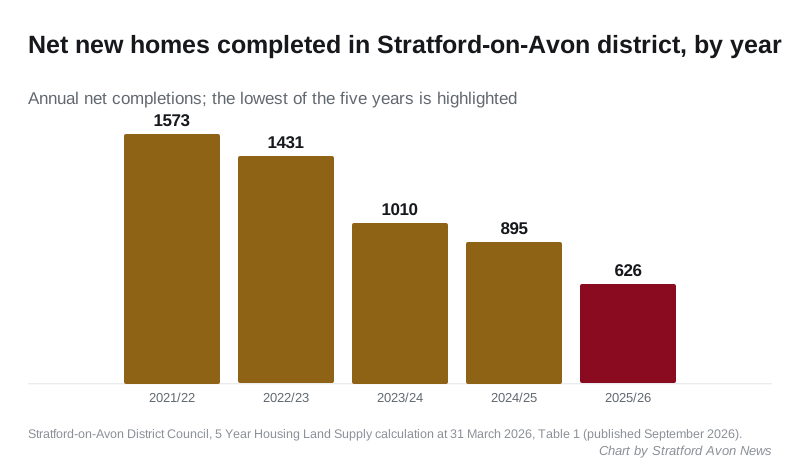
Past delivery is not part of the supply calculation itself. But it does decide the buffer. The government’s Housing Delivery Test, published in August 2026, measured the district at 202% of its requirement over 2022/23 to 2024/25, because 3,402 homes were delivered against a requirement of 1,686. That is why the buffer is 5% rather than the 20% applied to under-delivering councils.
Where the 2,407 homes are
The supply counts only sites that meet the government’s definition of deliverable. The breakdown in the paper:
- 1,096 homes on sites with full permission and under construction
- 98 on sites with full permission where initial works have started
- 687 with full permission, not started
- 61 on minor sites with outline permission
- 409 on major sites with outline permission, where the council says there is clear evidence of delivery within five years
- 56 on development plan allocations without permission yet
- none from resolutions to grant or permissions in principle
The windfall allowance rests on the district’s record of small sites. Between 2018/19 and 2025/26, sites of one to nine homes delivered an average of 171 a year. The council cut that by 5% to 162 and applied it only to 2029/30 and 2030/31.
Why a bigger number does not change much
The gap matters because of a rule in the National Planning Policy Framework. Where a council cannot show five years of deliverable sites, its policies for the supply of housing are treated as out of date. Applications are then judged on a “tilted balance”: permission should be granted unless the harm “significantly and demonstrably” outweighs the benefits.
That is the test the Planning Committee applied at Harbury on 7 October. The officer report for that site used the old 2.21 figure, and the update sheet told members that the move to 2.43 had “no material effect on the planning balance”. Councillors who voted to approve said they could find no planning reason to refuse. Our earlier story covered the same mechanism at four village sites in September.
The council’s five year housing supply page points to an Interim Policy Position Statement, endorsed by Cabinet on 1 June 2026, which explains which development plan policies still apply and how the council is handling applications in the meantime.
The long-term fix is the local plan
The route back to five years is the South Warwickshire Local Plan, prepared jointly with Warwick District Council. The Cabinet’s 5 October report on the Long Marston Airfield site gives the timetable: submission by December 2026, examination in 2027 and adoption in early 2028.
That report also records the scale of what the plan proposes. The Long Marston Airfield New Community is listed at 10,300 homes in total, with 4,500 by 2050, plus 15 hectares of employment land, a western bypass for Stratford and a solar farm. Cabinet approved a governance framework for the site on 5 October, with a strategic board of councillors, officers, landowners, developers and Homes England, and agreed that the board’s membership and terms of reference will be settled by a later leader decision. It was agreed with no votes against, according to the webcast. The plan has eighteen residential-led strategic sites in all.
What it means for you
- If you are objecting to a housing application: the land supply shortfall is the reason officers keep recommending approval on village edges. Objections that work are about specific harm, such as highway safety, flooding or heritage, not about the principle of building outside the settlement boundary.
- If you are waiting for a new home: the paper counts 1,096 homes on sites already under construction and 687 more with full permission that have not started. Delivery, not permission, is the bottleneck right now.
- For the next figure: the council’s page still says the next update is expected in August 2026, which has passed. The paper itself is the September 2026 update. Expect the next one about a year from now, with a base date of 31 March 2027.
Our planning news page and house prices page carry the related figures.
Have your say