
Officers will decide 53 of every 64 cases the committee heard last year, and parish objections stop sending plans to committee. The vote was 34 to 2.
Most planning applications in Stratford-on-Avon district will be decided by council officers from 31 October, not by the elected Planning Committee.
The district council approved the change on Monday 12 October by 34 votes to 2. Several councillors said they were voting for it reluctantly. It is forced on every council in England by new national rules.
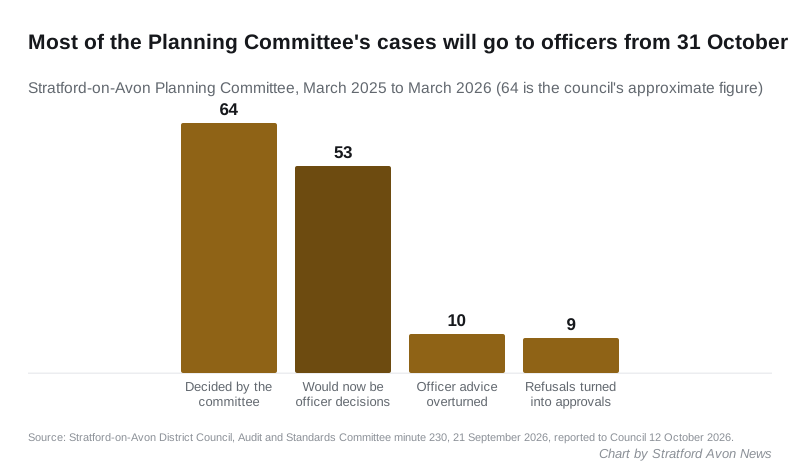
The council’s own figures show the scale. Of about 64 applications the committee decided between March 2025 and March 2026, 53 would not have reached it under the new rules.
What changes on 31 October
The rules are the Town and Country Planning (Discharge of Local Planning Authority Functions) (England) Regulations 2026. They create a national scheme of delegation, which sorts every application into one of two lists. The government has published guidance for councils on how they work.
Schedule 1 applications are always decided by officers. Stratford’s new constitution lists them. They include:
- householder applications, such as extensions and loft conversions
- minor residential and minor commercial applications
- certificates of lawful use
- prior approvals under permitted development rights
- reserved matters on all but large outline permissions
- applications to discharge planning conditions
- non-material changes to an existing permission
The only exception is an “own interest” application, made by or connected to the council, a councillor or an officer.
Schedule 2 covers the rest. That includes larger housing and commercial schemes, listed building consent, advertisements, work to protected trees and retrospective applications. These also go to officers unless they pass a new “Gateway Test”.
(Stratford-on-Avon District Council, revised constitution, Appendix 2)
Who decides whether a plan goes to committee
Two people hold the key. The constitution names the chair of the Planning Committee as the “Nominated Member” and the council’s Head of Development as the “Nominated Officer”. Both must agree before a Schedule 2 application goes to committee. If they do not agree, an officer decides it.
They must agree that the application raises either:
- “one or more issues of economic, social or environmental significance to the local area”; or
- “one or more significant planning matters having regard to the Development Plan and any other material considerations”
A ward councillor can ask for a referral, in writing, within three weeks of being told about the application. So can the planning officer handling it.
Town and parish councils are not given that right. Until now, a parish council objection was enough to send many applications to committee. Every item on the committee’s agenda for 21 October is there because a parish council, a ward councillor or both objected.
The council’s guidance on the test is tight. For most planning applications, a referral should only happen in two cases:
- the plan is a clear departure from the Development Plan, and officers recommend approval
- officers recommend refusal, but there are significant matters that could justify approval
For work to protected trees, a referral should only be considered when five or more members of the public have objected on planning grounds.
What the committee did with its cases last year
The analysis was given to the Audit and Standards Committee on 21 September. Between March 2025 and March 2026, the Planning Committee overturned ten officer recommendations. Nine of those were applications officers wanted to refuse that councillors granted.
That record matters for the new test, which still allows a referral where officers recommend refusal but councillors see grounds to approve.
What councillors said
Full Council took a recorded vote at the request of Cllr Sarah Whalley-Hoggins. It was 34 in favour and 2 against, with Cllr Ashley Jones and Cllr Whalley-Hoggins voting no. The vote and the remarks below are taken from the council’s webcast of the meeting.
Cllr Whalley-Hoggins called it “an appalling piece of legislation” and asked what the council had done to push back.
Cllr George Cowcher, the portfolio holder for planning, said it was “emasculating us as a planning authority”. He told the meeting he had written to the Secretary of State stating the council’s “complete opposition”. He said the council had to accept the changes, “very reluctantly”.
Cllr Ian Shenton said the crucial decision would now be whether an application reaches the committee at all. He asked the council to publish its Gateway decisions and the reasons for them, and to report how many referrals are asked for and refused.
The monitoring officer replied that residents, parish and town councils would be told what is happening from 31 October. There would also be training for parish and town councils, and performance management of the new process.
The Audit and Standards minute records that a Parish Forum has been arranged to brief town and parish councillors. One councillor told the meeting it is on 22 October.
The council’s report warned that not adopting the changes would leave it “open to legal challenge, reputational concern, financial challenge and media exposure”.
(Report to Audit and Standards Committee, 21 September 2026)
What it means for you
- If you are objecting to a neighbour’s extension or loft conversion, an officer will decide it from 31 October, whatever the parish council says. Your written objection still counts, so send it in on time through the council’s planning register.
- If you want a larger scheme heard in public, ask your district ward councillor to request a referral. They have three weeks from being notified, and the chair and the Head of Development must both agree.
- If you sit on a parish council, your objection becomes a consultation response rather than a route to committee. Brief your ward councillor early.
- Applications already on the 21 October agenda go ahead as normal. Our preview of that meeting has the details.
Our planning news page tracks the decisions that matter across the district.
Have your say